
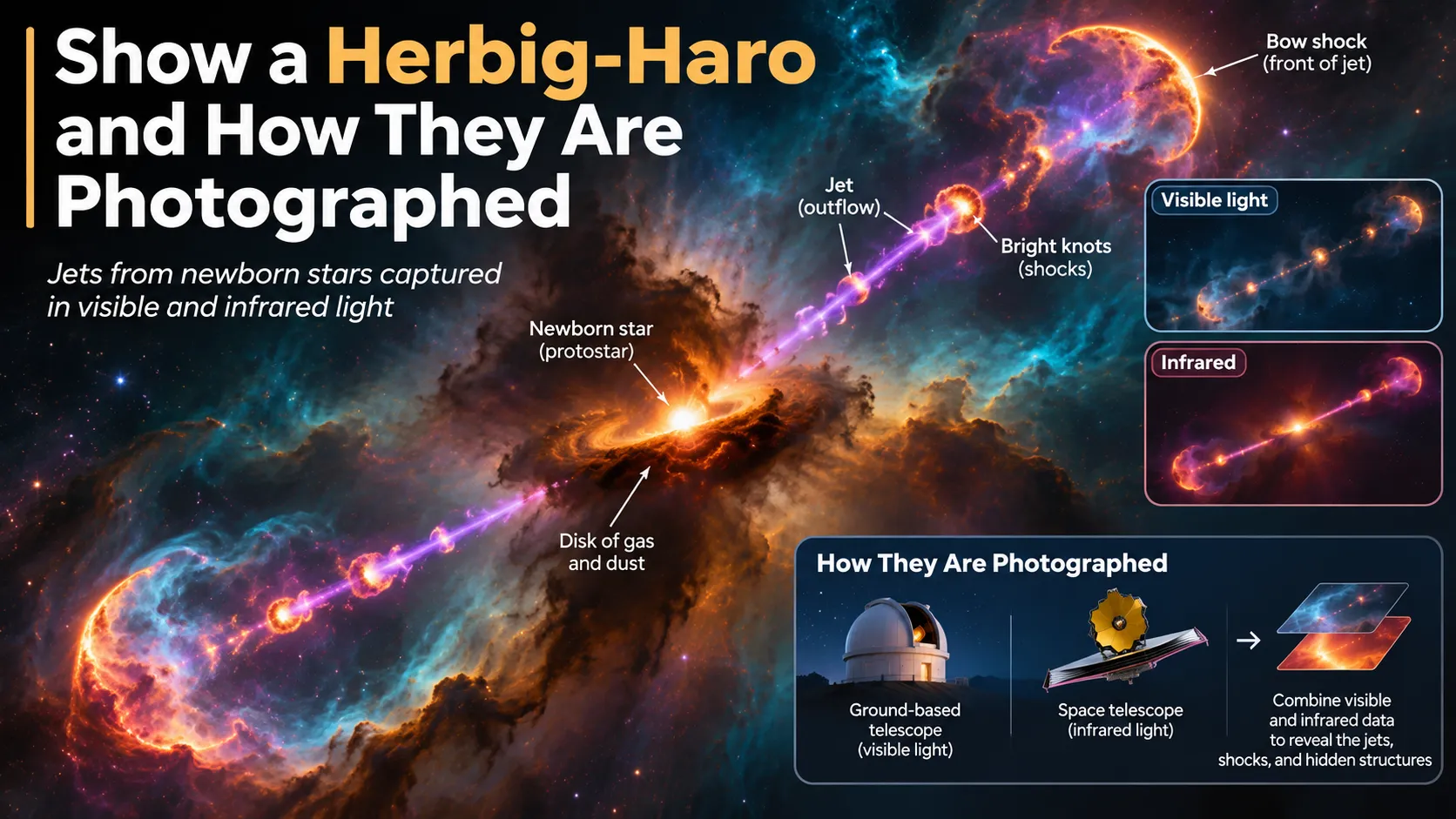
A Herbig-Haro object is a glowing region of gas created when powerful jets from a newborn star collide with surrounding interstellar material. Astronomers photograph these remarkable structures using powerful telescopes, including NASA’s Hubble Space Telescope and James Webb Space Telescope, which capture visible and infrared light to reveal the processes involved in star formation.
Herbig-Haro objects provide some of the clearest visual evidence of how young stars interact with their environments. Their colorful jets, bright knots, and curved shock waves reveal activity that would otherwise remain hidden inside enormous clouds of gas and dust.
Understanding how these objects form, what their photographs show, and how scientists produce those images offers a fascinating look at the earliest stages of stellar evolution.
What Is a Herbig-Haro Object?
A Herbig-Haro object, commonly abbreviated as an HH object, is a small region of glowing nebulosity associated with a newly forming star, or protostar.
These objects develop when narrow streams of material expelled from a young star move through space at extremely high speeds. When the jets collide with surrounding gas or previously ejected material, they generate shock waves that heat the gas and cause it to emit light.
The resulting structures often resemble colorful streams, bright knots, curved arcs, or miniature cosmic explosions.
However, Herbig-Haro objects are not actual stellar explosions. They are produced by continuing interactions between high-speed stellar outflows and their surroundings.
According to NASA’s explanation of Herbig-Haro 211, these objects are particularly useful for studying the earliest stages of star formation.
Why Are They Called Herbig-Haro Objects?
The name honors two astronomers:
- George Herbig: An American astronomer who investigated unusual bright nebulae associated with young stars.
- Guillermo Haro: A Mexican astronomer who independently studied similar objects and contributed significantly to understanding star-forming regions.
Both researchers studied these mysterious structures during the early 1950s.
Later observations established that many of the bright patches were connected to energetic jets emitted by young stars.
Today, astronomers identify individual objects using catalog designations such as HH 1, HH 2, HH 34, HH 211, and HH 46/47.
Show a Herbig-Haro: A Real Image of HH 211
One of the clearest examples of a Herbig-Haro object is HH 211, photographed by the James Webb Space Telescope.
Image: Herbig-Haro 211, photographed with Webb’s Near-Infrared Camera. Credit: ESA/Webb, NASA, CSA, T. Ray (Dublin Institute for Advanced Studies). View the original high-resolution image.
The photograph shows an extraordinary pair of jets extending in opposite directions from a young protostar.
The bright pink and orange structures are regions where material moving through space produces shock-heated gas. The central protostar is largely hidden by surrounding dust.
What Does the HH 211 Photograph Reveal?
HH 211 is located approximately 1,000 light-years from Earth in the constellation Perseus.
Webb’s image, released on September 14, 2023, revealed several important features:
- Two oppositely directed jets emerging from the central star-forming region.
- Bright curved structures known as bow shocks.
- Knots and irregularities indicating complex movements within the outflow.
- Infrared emission from molecules excited by the turbulent environment.
NASA reported that the innermost outflow structures have measured velocities of approximately 80 to 100 kilometers per second.
The jets also display a mirrored, wiggling pattern that researchers suggest may indicate an unresolved binary star system. This interpretation is supported by observations, but it does not establish the binary nature of the source conclusively.
The photograph demonstrates how infrared astronomy can expose structures that are difficult to study through visible light alone.
How Do Herbig-Haro Objects Form?
Herbig-Haro objects form during an active period in a star’s early development, when the young star is still accumulating matter from its surroundings.
The process involves gravity, rotating gas, magnetic fields, and energetic jets.
1. A Protostar Develops Inside a Molecular Cloud
Stars begin forming inside cold, dense clouds of gas and dust known as molecular clouds.
Gravity causes parts of these clouds to contract. As material gathers toward the center, it forms a developing stellar object called a protostar.
The infalling material also creates a rotating disk around the young star.
This disk is important because it supplies material that contributes to the protostar’s growth.
2. Powerful Jets Escape From the Young Star System
Some of the material associated with the accretion process is redirected into narrow, high-speed outflows.
Magnetic fields are thought to play a central role in launching and directing these jets.
The material frequently travels outward in two opposite directions, roughly along the rotational axis of the star-disk system.
These structures are called bipolar jets.
3. Shock Waves Heat the Surrounding Gas
As the jets move through their environment, they encounter slower gas and dust.
Collisions compress and heat the material, creating shock fronts.
Atoms, ions, and molecules in the disturbed gas emit radiation as the material cools.
Depending on the conditions, this radiation can include visible light and infrared emission.
The glowing shock regions are what astronomers identify as Herbig-Haro objects.
4. Bright Knots and Curved Structures Develop
The speed and intensity of stellar jets can vary over time.
Faster material may overtake slower material, producing additional shock waves along the jet.
These interactions create distinct bright knots and curved features.
Observing their positions and movements can help scientists reconstruct the history of material ejected from the forming star.
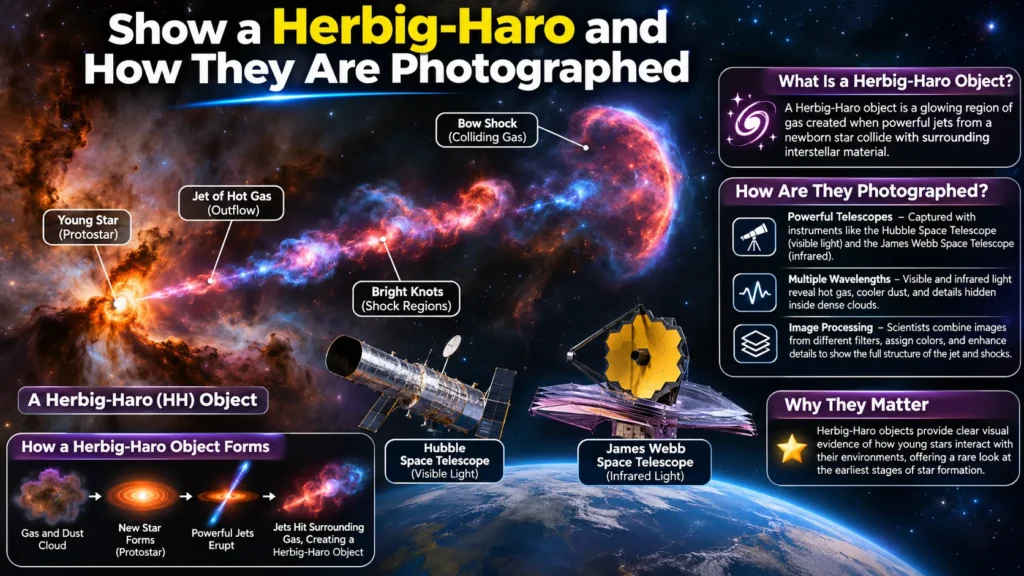
How Are Herbig-Haro Objects Photographed?
Herbig-Haro objects are photographed by collecting the faint light emitted by their gas and converting that information into detailed astronomical images.
The process requires specialized cameras, suitable filters, sensitive detectors, and careful image processing.
Unlike ordinary daytime photography, astronomers frequently combine multiple exposures and observations made at different wavelengths.
Step 1: Locating the Object
Astronomers first identify the object’s location using astronomical catalogs and earlier observations.
Each target has celestial coordinates called right ascension and declination, which allow telescopes to point toward a specific region of the sky.
Researchers also consider the object’s apparent size, brightness, surrounding dust, and the type of radiation they want to investigate.
These factors help determine which telescope and camera will be most effective.
Step 2: Selecting the Right Telescope
Different telescopes reveal different characteristics of Herbig-Haro objects.
Hubble Space Telescope
Hubble can observe visible, ultraviolet, and near-infrared light using instruments such as Wide Field Camera 3.
Its high-resolution observations reveal narrow jets, emission regions, and changes in the positions of bright knots.
James Webb Space Telescope
Webb specializes in infrared astronomy.
Its Near-Infrared Camera (NIRCam) and Mid-Infrared Instrument (MIRI) can examine structures within dusty star-forming environments.
Infrared observations are valuable because longer-wavelength light is generally less affected by interstellar dust than visible light.
Ground-Based Observatories
Large ground-based telescopes, including those operated by the European Southern Observatory (ESO), can also photograph Herbig-Haro objects.
They often use sensitive astronomical cameras and narrowband filters that isolate radiation emitted by particular gases.
Observing conditions, atmospheric turbulence, telescope size, and instrument sensitivity influence the resulting image quality.
Step 3: Capturing Light Through Special Filters
Astronomical cameras collect light through filters selected for specific wavelengths.
These filters help scientists distinguish different physical processes within the gas.
| Light or spectral feature | What it can reveal |
|---|---|
| Hydrogen-alpha (Hα) | Emission from excited hydrogen in ionized regions |
| Sulfur II ([S II]) | Shock-excited, relatively low-ionization gas |
| Oxygen III ([O III]) | More highly ionized gas where excitation conditions permit |
| Near-infrared molecular emission | Molecular material and outflows partly hidden by dust |
| Mid-infrared radiation | Additional information about dust and gas within star-forming environments |
Not every Herbig-Haro object is equally bright at all these wavelengths. The appropriate filters depend on its temperature, chemical composition, excitation conditions, and degree of obscuration.
In some cases, several exposures are taken through the same filter to improve the clarity of faint structures.
Step 4: Combining and Processing the Images
The original observations are often recorded as separate monochromatic images.
Scientists and image-processing specialists calibrate these exposures, correct instrumental effects, remove unwanted artifacts, and align the astronomical features.
They may then combine multiple images to improve the signal-to-noise ratio or create a larger view of the target.
Different filtered exposures can be assigned visible colors and merged into a composite photograph.
According to the European Space Agency’s explanation of Webb image processing, this approach helps make otherwise invisible wavelength information understandable to human viewers.
Step 5: Interpreting the Scientific Details
The completed image is more than a visual representation.
Astronomers examine the shape, brightness, and distribution of features to investigate the structure of the outflow.
Repeated observations can reveal how bright knots move over time.
Researchers can also combine imaging with spectroscopy, which separates light into its component wavelengths, to investigate gas velocities, chemical signatures, and physical conditions.
These measurements provide information that cannot reliably be obtained from image colors alone.
Why Do Herbig-Haro Photographs Have Such Bright Colors?
Many famous Herbig-Haro photographs contain intense shades of pink, orange, blue, green, and purple.
Those colors do not necessarily represent how the objects would appear to human eyes.
Instead, astronomical images often use representative color, in which observations collected at different wavelengths are assigned visible colors.
For example, a Webb photograph may display shorter infrared wavelengths in bluish tones and longer infrared wavelengths in orange or red.
This makes it easier to distinguish structures that emit radiation in different parts of the spectrum.
Are These Photographs Real or Artificially Colored?
The photographs are based on real astronomical observations.
However, the colors may be assigned during processing rather than recorded as ordinary visible colors.
That distinction is particularly important for infrared images because the human eye cannot detect most of the radiation collected by Webb.
Image processing does not mean the observed jets and shock waves have been invented.
The physical structures are present in the recorded data, although their visual presentation depends on how the information is processed.
Famous Herbig-Haro Objects Captured by Telescopes
Several well-studied examples demonstrate how different imaging techniques reveal the behavior of newborn stars.
HH 34: A Detailed View of Stellar Jets
Herbig-Haro 34 is located in the constellation Orion, approximately 1,500 light-years from Earth.
It is particularly valuable for studying the structure and evolution of stellar jets.
In November 1999, astronomers used ESO’s Very Large Telescope facilities to photograph HH 34 with the FORS2 instrument.
The published composite combined three filtered observations:
- Blue-band light: 10-minute exposure.
- Hydrogen-alpha light: 30-minute exposure.
- Sulfur II light: 30-minute exposure.
The resulting image revealed a complicated system of gas jets and surrounding nebulosity.
This is a particularly useful example because ESO published the actual observing filters, wavelengths, and exposure times.
View ESO’s original HH 34 photograph and technical imaging details.
HH 46/47: Twin Jets From Forming Stars
HH 46/47 is a well-known star-forming system located approximately 1,470 light-years away in the constellation Vela.
On July 26, 2023, NASA released a detailed Webb image showing a closely associated pair of actively forming stars surrounded by energetic outflows.
The composite was produced from six near-infrared NIRCam images.
Its orange lobes and surrounding structures reveal material expelled during the stars’ development.
The image also demonstrates Webb’s ability to reveal star-forming activity within dusty clouds.
Explore NASA’s Webb photograph of HH 46/47.
HH 49/50: The Cosmic Tornado
HH 49/50 is located around 625 light-years away in the constellation Chamaeleon.
It received attention because older infrared observations showed an unusual, swirling structure resembling a tornado.
On March 24, 2025, NASA published a detailed Webb image combining NIRCam and MIRI observations.
The improved resolution exposed intricate structures within the shocked gas.
It also revealed that a previously mysterious object appearing at the end of the outflow was actually a distant spiral galaxy seen along the same line of sight.
The galaxy is not a physical part of the Herbig-Haro outflow.
This discovery illustrates why higher-resolution imaging can change scientists’ interpretation of an astronomical scene.
See the Webb image of HH 49/50 and its comparison with Spitzer.
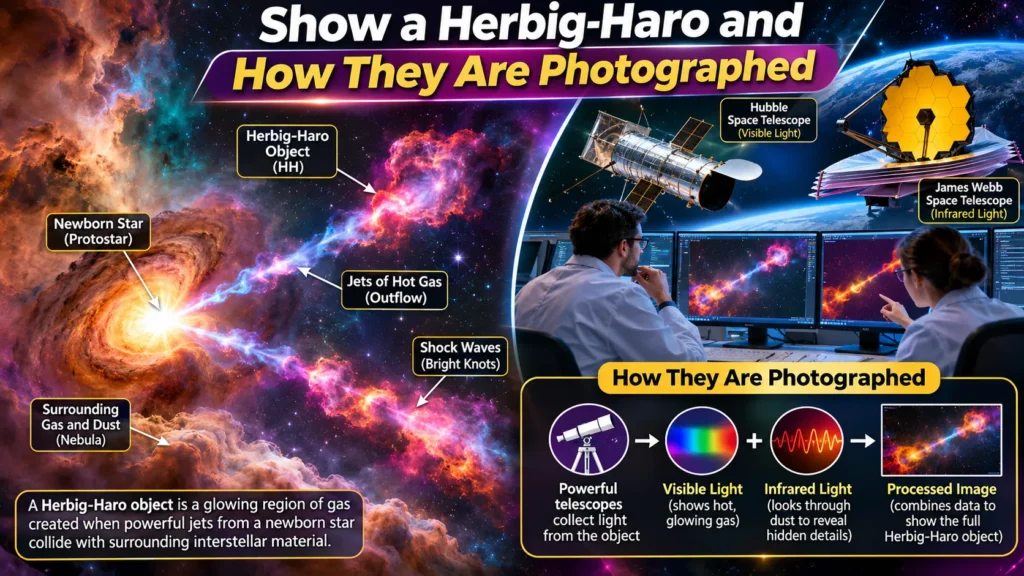
How Modern Telescope Images Reveal Movement in Space
Herbig-Haro objects are not stationary formations.
Their glowing knots and shock fronts can travel at hundreds of kilometers per second, although the speeds vary significantly from one system to another.
Because the objects are so distant, their movement is generally difficult to notice in a single observation.
However, photographs captured years or decades apart can reveal changes in position and structure.
Hubble’s 2026 Observations of HH 399
A notable example is Herbig-Haro 399, a stellar jet associated with the Trifid Nebula.
On April 20, 2026, NASA released a comparison of Hubble observations obtained in 1997 and 2026.
The 29-year interval revealed the expansion of the jet and other changes within the surrounding nebular structures.
The images provide direct observational evidence that the gas is moving over astronomically short periods.
They also demonstrate how long-term monitoring can reveal processes that a single photograph cannot show.
Watch NASA’s comparison of the 1997 and 2026 Trifid Nebula observations.
Can Amateur Astronomers Photograph Herbig-Haro Objects?
Yes, some Herbig-Haro objects can be photographed from Earth with suitable amateur astrophotography equipment.
However, capturing a detailed image is considerably more challenging than photographing bright targets such as the Moon, Orion Nebula, or Andromeda Galaxy.
Many Herbig-Haro objects are extremely faint, relatively small, or obscured by surrounding dust.
For these reasons, successful imaging generally requires more specialized equipment and careful planning.
Equipment That May Be Useful
A serious attempt typically involves:
- A tracking telescope mount: Compensates for Earth’s rotation during long exposures.
- A telescope with suitable image scale and light-gathering ability: Helps resolve small structures and collect faint light.
- A sensitive astronomical camera: Records weak signals from faint nebular features.
- Appropriate filters: Hydrogen-alpha and sulfur II filters may help isolate shock-related emission where those lines are strong.
- Image-processing software: Supports calibration, alignment, stacking, and contrast adjustment.
Dark skies, accurate focus, stable tracking, and favorable atmospheric conditions are also important.
Practical Steps for Photographing a Target
An amateur astronomer could begin by researching a well-documented region such as HH 34 in Orion.
The next step would be to locate the object using reliable astronomical coordinates and confirm whether the equipment provides adequate image scale.
Multiple guided exposures could then be collected through appropriate filters.
After calibration and stacking, the observer could examine the image for small bright knots and jet-like structures.
There is no universal exposure duration that guarantees success. The necessary integration time depends on the telescope, camera, sky brightness, filter transmission, and the specific target.
Professional observatory images remain a more reliable way to examine the finest details.
A typical smartphone or ordinary camera lens will not resolve the delicate structures shown in Hubble and Webb photographs.
What Can Scientists Learn From Herbig-Haro Images?
Herbig-Haro observations help astronomers investigate the behavior of stars during their earliest developmental stages.
They are particularly valuable because jets interact directly with the material surrounding newly forming stars.
Understanding the Star Formation Process
By studying jets, astronomers gain insight into how developing stellar systems redistribute material and angular momentum.
Magnetic fields and the interaction between the protostar and its surrounding disk are central parts of current models.
Images help identify structures that can be compared with theoretical predictions.
Measuring Gas Motion
Photographs taken at different times allow researchers to measure apparent movement across the sky.
When combined with spectroscopic measurements of motion toward or away from Earth, these observations can help establish the three-dimensional behavior of the gas.
Such measurements also reveal differences between individual jet systems.
Investigating Shock Waves
Bright knots and curved shock fronts provide opportunities to study how supersonic flows interact with surrounding matter.
Their emission can reveal conditions within the shocked gas.
Scientists use these observations to test physical models of heating, cooling, turbulence, and jet evolution.
Reconstructing the History of Young Stars
A stellar jet can preserve evidence of changes in the activity of its source.
Different knots may reflect material expelled during separate episodes.
Studying their positions and velocities helps astronomers estimate when those episodes occurred, subject to assumptions about the geometry and motion of the outflow.
Important Limitations of Herbig-Haro Photography
Although astronomical images provide valuable information, they also have limitations.
Dust can hide portions of a system, while some gases produce little radiation at the wavelengths being observed.
A photograph therefore represents a particular view of the object rather than a complete picture of every physical component.
Distance and orientation create additional challenges. A jet directed partly toward Earth may appear shorter than one lying mostly across our line of sight.
Furthermore, the brightness of a feature does not automatically establish its temperature, speed, or mass.
Reliable scientific interpretations frequently require imaging at multiple wavelengths, spectroscopy, computer modeling, and observations taken over time.
Understanding these limitations is essential when interpreting the spectacular images released by space agencies.
Frequently Asked Questions
What Does a Herbig-Haro Object Look Like?
A Herbig-Haro object often appears as a narrow glowing jet, a series of bright knots, or a curved shock front surrounded by gas and dust. Its exact appearance depends on the direction of the outflow, surrounding material, and wavelengths used to photograph it.
How Do Astronomers Photograph Herbig-Haro Objects?
Astronomers use optical and infrared telescopes equipped with sensitive detectors and specialized filters. Multiple exposures are calibrated, aligned, and combined to reveal structures that may be too faint to see in individual images.
Can Herbig-Haro Objects Be Seen With the Naked Eye?
No, individual Herbig-Haro structures are generally too faint and small to distinguish without specialized instruments. Even when they occur within a visible nebula, their detailed jets and shock fronts usually require telescope imaging.
Why Are Infrared Telescopes Useful for Photographing Them?
Infrared observations can reveal structures hidden behind interstellar dust that blocks much of the visible light. They can also detect radiation from excited molecules within young stellar outflows.
Are the Colors in NASA’s Herbig-Haro Pictures Real?
The underlying observations are real, but many published images use representative colors. Different wavelengths, including invisible infrared radiation, are assigned visible colors to help viewers distinguish physical structures.
How Fast Do Herbig-Haro Jets Travel?
Their speeds vary between objects. For example, NASA reported velocities of approximately 80 to 100 kilometers per second in the inner outflow structures of HH 211, while other stellar jets can move considerably faster.
Why Herbig-Haro Photography Matters
Herbig-Haro photographs reveal a dramatic but relatively brief chapter in the life of a forming star.
What appears to be a colorful cloud is actually evidence of fast-moving material, shock waves, and complex interactions between a protostar and its environment.
The combination of Hubble’s detailed observations, Webb’s infrared capabilities, and ground-based astronomical imaging gives scientists complementary ways to investigate these processes.
Images collected years apart can even reveal physical changes, transforming astronomical photography into a powerful tool for studying how stars form and evolve.
Also Read: Briggs & Riley #work Medium Expandable Briefcase Review (2026)