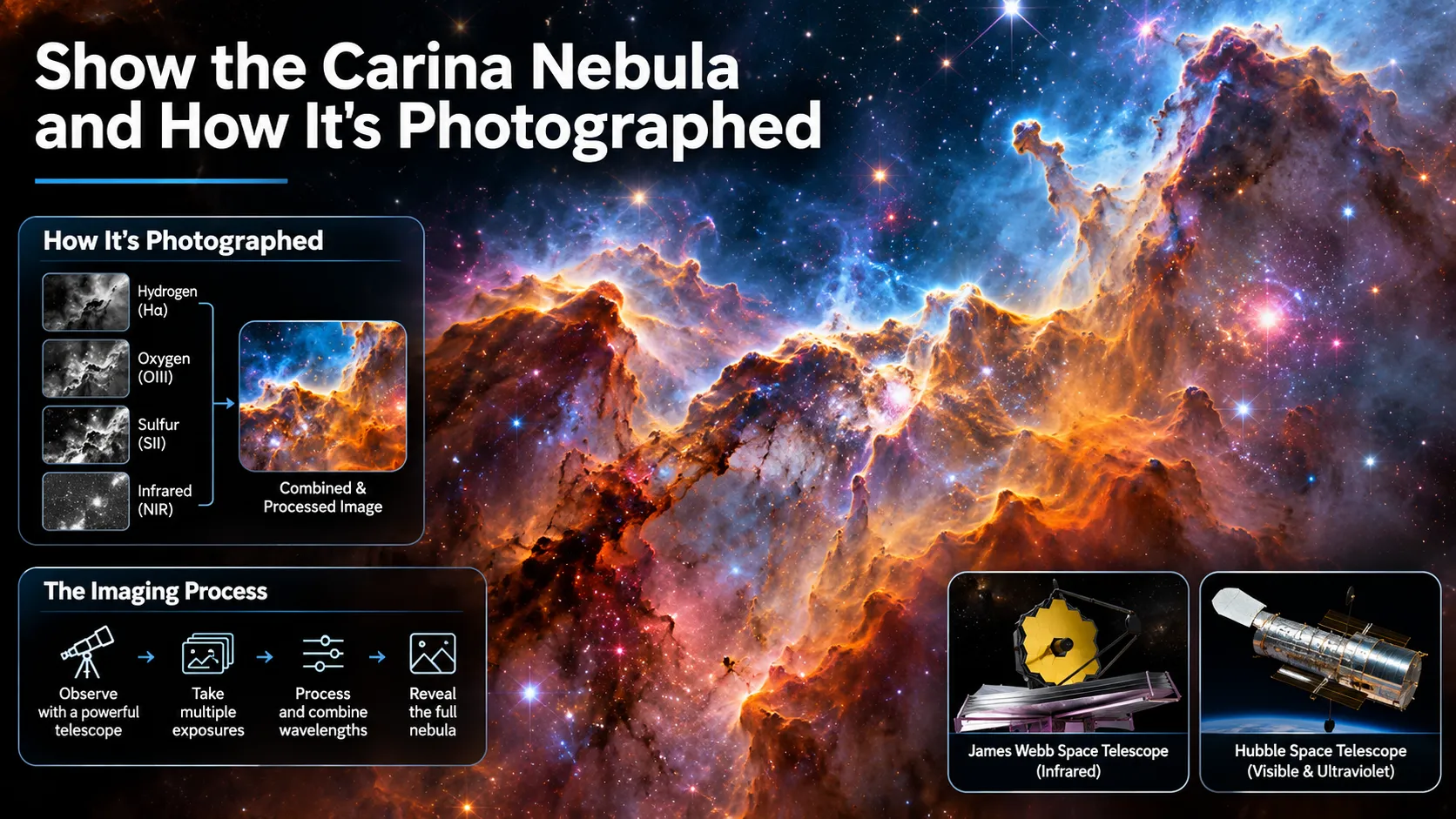
The Carina Nebula is a vast, glowing cloud of gas and dust approximately 7,500 light-years from Earth. Its spectacular photographs are captured using powerful telescopes, specialized cameras, infrared observations, and image-processing techniques that reveal stars and structures often invisible to the human eye.
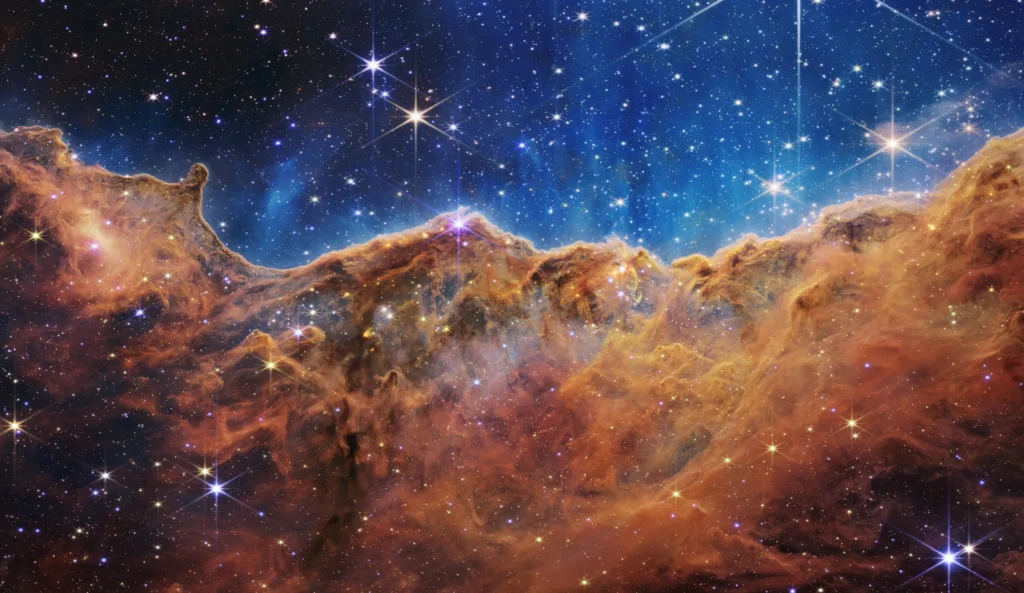
Among its most famous photographs is the Cosmic Cliffs, captured by NASA’s James Webb Space Telescope and released on July 12, 2022. The image shows enormous formations of gas and dust illuminated by young stars, offering a remarkable view of how stars form within our Milky Way galaxy.
These images are genuine astronomical observations, although their colors are carefully processed to make different wavelengths of light visible and scientifically meaningful.
What Is the Carina Nebula?
The Carina Nebula, also known as NGC 3372 or Caldwell 92, is one of the Milky Way’s largest and most active star-forming regions. It is located in the southern constellation Carina, whose name means the keel of a ship.
The nebula extends across approximately 300 light-years and contains enormous clouds of hydrogen gas, cosmic dust, young stars, and some of the most massive stars known in our galaxy.
Unlike a planet or a solid astronomical object, a nebula is a vast collection of material spread across space. Within the Carina Nebula, gravity causes portions of dense gas and dust to collapse, eventually producing new stars.
Its striking appearance results partly from the intense radiation and powerful stellar winds produced by massive stars. These forces illuminate surrounding gas, carve cavities into clouds, and create towering structures resembling mountains.
According to NASA’s Caldwell 92 overview, the Carina Nebula is sufficiently bright to be observed without a telescope under favorable southern skies.
Quick Facts About the Carina Nebula
| Feature | Details |
|---|---|
| Official designation | NGC 3372 |
| Alternative name | Caldwell 92 |
| Location | Constellation Carina |
| Galaxy | Milky Way |
| Distance from Earth | Approximately 7,500 light-years |
| Estimated extent | About 300 light-years |
| Object type | Emission nebula and star-forming region |
| Famous stellar system | Eta Carinae |
| Best observation region | Southern Hemisphere |
| Major imaging telescopes | Hubble, James Webb, and ground-based observatories |
Show the Carina Nebula and How It’s Photographed by NASA
Some of the most detailed images of the Carina Nebula have been produced by the James Webb Space Telescope and the Hubble Space Telescope. Although both observe the same enormous region, their different instruments reveal distinct astronomical features.
1. James Webb’s Cosmic Cliffs Photograph
View the original Carina Nebula Cosmic Cliffs photograph from NASA and ESA
Image credit: NASA, ESA, CSA, and STScI. Released July 12, 2022.
The Cosmic Cliffs image resembles an extraordinary landscape, featuring enormous golden-brown ridges beneath a deep blue, star-filled background.
However, the apparent mountains are not rocky formations. They are towering structures of interstellar gas and dust along the edge of a star-forming region called NGC 3324, located within the larger Carina Nebula.
NASA reports that some of the tallest structures visible in this scene reach approximately seven light-years in height.
The bright stars above the clouds emit intense radiation that gradually erodes the surrounding material. Meanwhile, younger stars remain hidden within the dense clouds, where they continue forming.
Webb’s Near-Infrared Camera, known as NIRCam, helped reveal previously obscured stars and details of this extraordinary environment.
The photograph is particularly important because it allows astronomers to investigate the relationship between massive stars, surrounding clouds, and newly forming stellar systems.
2. Hubble’s Mystic Mountain Photograph
View NASA’s original Mystic Mountain photograph
Image credit: NASA, ESA, and the Hubble 20th Anniversary Team.
The Hubble Space Telescope captured another remarkable part of the Carina Nebula known as Mystic Mountain.
Released in 2010, this image shows a towering pillar of gas and dust approximately three light-years tall. Its irregular shape resembles a mountain rising through an illuminated cosmic landscape.
The structure contains signs of ongoing star formation, including jets of material expelled by developing stars.
Hubble captured the region using its Wide Field Camera 3, which can observe selected wavelengths of visible and infrared light.
The resulting image reveals intricate details of the surrounding gas, including regions affected by radiation from nearby massive stars.
3. The Carina Nebula in a Wide-Field Photograph
Explore NASA’s panoramic Carina Nebula image
Unlike close-up photographs of the Cosmic Cliffs or Mystic Mountain, wide-field images show larger portions of the Carina Nebula.
In 2007, NASA released a major Hubble panorama covering approximately 50 light-years across the nebula’s central region.
The image combines detailed Hubble observations with color information acquired at the Cerro Tololo Inter-American Observatory in Chile.
Scientists used a mosaic of 48 Hubble frames to produce this detailed view.
Such panoramic photographs help astronomers understand how separate clouds, stellar clusters, and energetic regions interact across enormous distances.
How Is the Carina Nebula Photographed?
Photographing the Carina Nebula requires specialized techniques because much of its light is faint, and some of its most interesting features are hidden behind cosmic dust.
Professional observatories use sensitive detectors, carefully selected wavelengths, multiple exposures, and computer-based processing to produce detailed astronomical images.
Step 1: Observing the Nebula Through a Powerful Telescope
The process begins by directing a telescope toward the Carina Nebula.
Professional telescopes such as Hubble and James Webb collect light using large mirrors and specialized optical instruments.
Hubble operates above Earth’s atmosphere, avoiding atmospheric distortion that affects ground-based observations. Webb operates much farther from Earth and was designed primarily to detect infrared radiation.
Infrared observations are especially useful because longer wavelengths can pass through some dusty regions that block visible light.
As a result, Webb can reveal young stars and embedded structures that remain hidden in many ordinary optical photographs.
Step 2: Capturing Light Through Different Filters
Astronomical cameras frequently record separate images using filters that isolate different wavelength ranges.
These wavelengths provide information about the stars, dust, and gas within the nebula.
For example:
- Hydrogen-alpha: Helps reveal glowing hydrogen gas.
- Oxygen emission: Highlights regions containing ionized oxygen.
- Sulfur emission: Reveals additional structures within energized gas.
- Near-infrared wavelengths: Can expose stars obscured by dust.
- Mid-infrared wavelengths: Help researchers study warm dust and embedded stellar objects.
Each filter records a different aspect of the astronomical environment.
The James Webb Space Telescope’s NIRCam and Mid-Infrared Instrument, or MIRI, provide complementary observations of the Carina Nebula.
According to the European Space Agency’s Cosmic Cliffs image documentation, combining these instruments allows astronomers to identify additional young stars, dusty structures, and outflows of material.
Step 3: Taking Multiple Exposures
Astronomical photography often requires collecting light over extended periods rather than taking a single ordinary photograph.
Individual exposures record faint signals from distant astronomical objects. Multiple exposures can then be combined to improve the quality of the final result.
For ground-based photographers, a tracking mount helps compensate for Earth’s rotation so stars remain sharp during longer exposures.
Professional space telescopes use precise pointing systems to keep their instruments accurately directed toward the target.
Combining multiple observations helps improve the signal-to-noise ratio, which makes faint details easier to distinguish from unwanted electronic noise.
Step 4: Processing the Image Data
Raw astronomical images often look very different from the colorful photographs published by NASA.
Individual observations through a single filter generally begin as monochrome images containing brightness information.
Image-processing specialists then calibrate and align the observations, correct instrumental artifacts, and adjust their intensity ranges to reveal faint structures.
Different filters can be assigned visible colors before the separate images are combined.
NASA explains this process in its official guide, How Are Webb’s Full-Color Images Made?.
Processing is not simply decorative. It allows researchers to distinguish physical structures and communicate what different instruments detect.
Are the Carina Nebula’s Colors Real or Artificial?
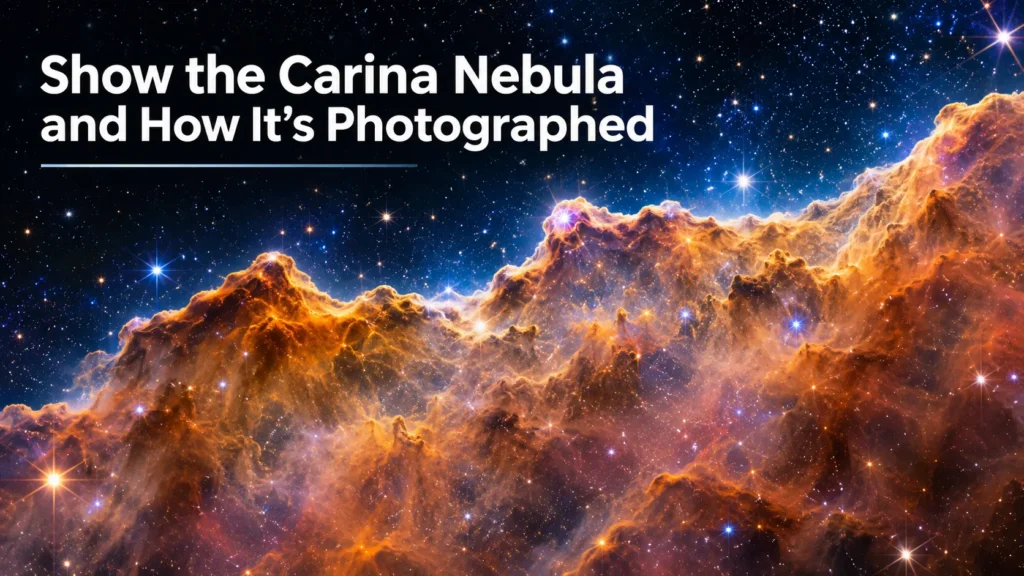
The Carina Nebula is a real astronomical object, and the structures shown in NASA photographs are based on actual telescope measurements. However, the exact colors in a published image do not necessarily represent how a human observer would see the nebula.
This distinction is particularly important for photographs captured by James Webb.
Human eyes detect only a relatively narrow range of electromagnetic radiation known as visible light. Webb primarily observes infrared wavelengths, which fall outside that range.
To make infrared observations understandable, imaging specialists assign visible colors to different wavelength measurements.
Often, shorter observed wavelengths receive relatively bluer colors, while longer wavelengths receive relatively redder colors. The specific mapping can vary depending on the scientific purpose and instruments used.
Why Does the Carina Nebula Look Blue, Orange, and Brown?
The famous Cosmic Cliffs photograph features blue regions above dense golden-orange clouds.
These colors represent processed infrared observations rather than a direct simulation of normal human vision.
The image’s color assignments help separate regions containing stars, gas, and dust, making structures easier to recognize.
Similarly, Hubble images may assign colors to particular emission lines from oxygen, hydrogen, nitrogen, and sulfur.
The important distinction is that scientifically assigned colors do not make the underlying image fictional. The structures and measured light are genuine, even when their colors have been translated for human viewing.
Hubble vs. James Webb: Which Photographs the Carina Nebula Better?
Neither telescope is universally better for every type of observation. Hubble and Webb examine different wavelength ranges, allowing scientists to investigate complementary aspects of the Carina Nebula.
| Feature | Hubble Space Telescope | James Webb Space Telescope |
|---|---|---|
| Main relevant wavelengths | Visible, ultraviolet, and near-infrared | Near- and mid-infrared |
| Key imaging strength | Detailed views of glowing gas and stellar structures | Revealing stars and structures obscured by dust |
| Notable Carina image | Mystic Mountain | Cosmic Cliffs |
| Observational advantage | Detailed optical structure and selected emission lines | Greater sensitivity to infrared light |
| Main limitation | Dust can block visible-light observations | Infrared images require color translation for viewing |
Hubble’s observations are valuable for studying how powerful stars shape nearby gas clouds.
Webb’s infrared instruments provide additional information about hidden stars, dust, and younger stellar populations.
Combining observations from both telescopes produces a more complete scientific understanding than relying on either instrument alone.
NASA demonstrated this especially clearly in October 2026 with its Cat’s Head Nebula comparison, showing visible-light, near-infrared, and mid-infrared views of a dusty structure within Carina.
Can You Photograph the Carina Nebula Yourself?
Yes. Amateur astrophotographers can capture impressive photographs of the Carina Nebula using suitable cameras, tracking equipment, and dark-sky observing conditions.
The nebula is large and relatively bright compared with many deep-sky objects, making it an attractive target for experienced amateur astronomers and enthusiastic beginners with appropriate equipment.
However, results depend heavily on geographic location, weather, camera sensitivity, exposure time, and light pollution.
What Equipment Do You Need?
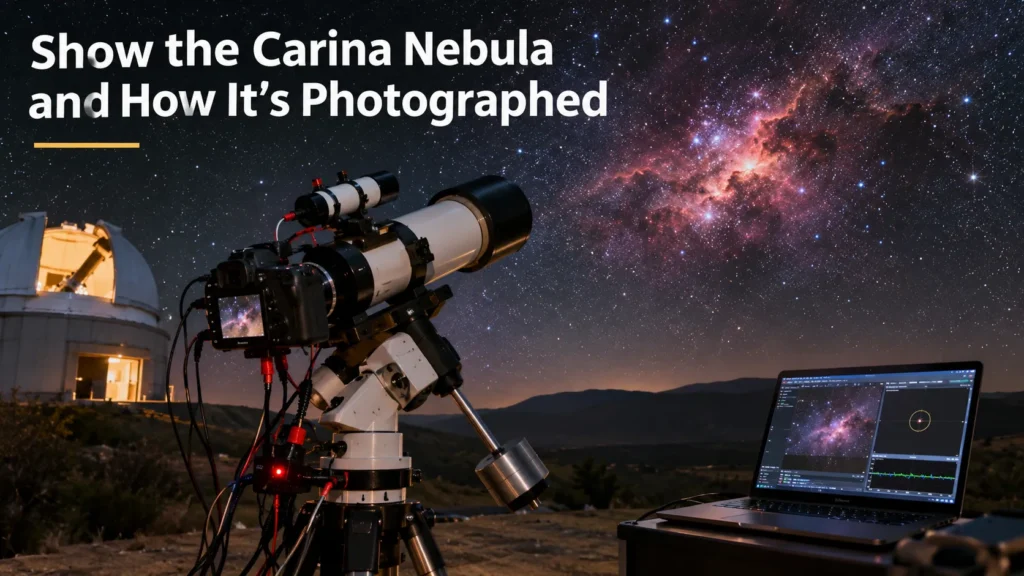
A basic astrophotography setup may include:
- A DSLR, mirrorless camera, or dedicated astronomy camera.
- A sturdy tripod and preferably a motorized star-tracking mount.
- A telephoto lens or small refracting telescope.
- A remote shutter release or computerized imaging controller.
- Optional nebula filters, including hydrogen-alpha and oxygen filters where compatible with the camera.
- Image-stacking and editing software.
A telescope is not essential for every photograph. The Carina Nebula’s large apparent size makes wider-field compositions possible with camera lenses.
A telescope becomes more useful when photographing smaller structures or regions near Eta Carinae.
How to Photograph the Carina Nebula Step by Step
1. Choose the right observing location.
Find a dark observing site with a clear southern horizon. Reduce interference from artificial lighting and avoid cloudy or hazy conditions.
2. Locate NGC 3372.
Use a planetarium application or astronomy sky chart to find the nebula in the constellation Carina. Its position and height above the horizon depend on your observing latitude and the time of year.
3. Set up and align the tracking mount.
Accurate polar alignment helps minimize star trails during longer exposures. Keep the camera securely mounted and check tracking accuracy before starting a lengthy imaging session.
4. Focus carefully on the stars.
Use manual focus and magnified live view to make bright stars appear as small and sharp as possible. Autofocus is often unreliable in dark astronomical scenes.
5. Capture multiple photographs.
For a tracked setup, individual exposures of roughly 30 to 180 seconds can serve as an initial experiment, depending on the equipment and sky conditions. These are illustrative starting settings, not universal recommendations.
Check the first exposures to avoid overexposing bright stars or producing elongated star shapes.
6. Stack and process the images.
Combine suitable frames using astrophotography software. Calibration frames, such as darks and flats, may help remove sensor artifacts and uneven illumination.
Finally, adjust brightness, contrast, background levels, and color balance while preserving genuine astronomical detail.
What Is the Best Time to Photograph the Carina Nebula?
The Carina Nebula is most conveniently observed from the Southern Hemisphere, particularly around its favorable evening visibility period in the southern autumn.
March and April are generally attractive months for observing it during the evening, although the best conditions depend on the location and observing schedule.
NASA notes that observers near the equator in the Northern Hemisphere may also see it low above the southern horizon during northern spring.
Farther north, it may remain below the horizon entirely.
Good photographs require more than a suitable month. Moonlight, atmospheric transparency, clouds, and light pollution all influence the final image.
For accurate planning, consult a current sky chart showing the nebula’s altitude from your location.
Why Is the Carina Nebula Important to Astronomers?
The Carina Nebula provides an exceptional environment for studying the formation and evolution of massive stars.
Its enormous stellar population includes young stars still developing, massive stars emitting powerful radiation, and surrounding clouds responding to energetic stellar activity.
Understanding How Stars Form
Stars form when sufficiently dense regions of gas and dust collapse under gravity.
As material accumulates, the central object becomes hotter and denser. Under the right conditions, nuclear fusion eventually begins, marking the development of a hydrogen-burning star.
Within the Carina Nebula, astronomers can observe different stages of this process across neighboring regions.
Infrared photography is particularly valuable because it helps reveal young stellar objects hidden within dusty clouds.
Studying Eta Carinae
One of the region’s most remarkable objects is Eta Carinae, an extremely luminous and unstable stellar system.
It consists of at least two stars, including a highly massive primary star.
Eta Carinae is famous for its nineteenth-century Great Eruption, during which it became extraordinarily bright and expelled enormous quantities of material.
Astronomers continue studying the system to understand massive-star evolution, stellar winds, and violent outbursts.
Its radiation and winds also contribute to the energetic environment surrounding parts of the Carina Nebula.
Investigating Stellar Feedback
Massive stars can both encourage and inhibit the formation of new stars.
Their radiation and winds may compress nearby gas, potentially triggering gravitational collapse in some regions. However, the same processes can disperse clouds and remove material needed for future star formation.
Astronomers call these interactions stellar feedback.
The Carina Nebula provides detailed examples of this complex relationship, making it a valuable natural laboratory for investigating how stars influence their surroundings.
Recent Carina Nebula Photographs and Discoveries in 2026
Although the Cosmic Cliffs photograph remains one of the most recognizable Webb images, astronomers have continued publishing new observations of the Carina Nebula.
August 2026: Webb’s Treasure Chest
On August 6, 2026, NASA and ESA presented a Webb infrared photograph of a structure nicknamed the Treasure Chest.
The image features a cometary globule, a dense cloud of gas and dust with a compact head and an elongated tail-like shape.
Such structures are influenced by powerful radiation and stellar winds in their surrounding environment.
The image offers another perspective on the way energetic stars shape the Carina Nebula.
View NASA’s Treasure Chest image and explanation
October 2026: The Cat’s Head Nebula
On October 29, 2026, NASA published a detailed comparison of the Cat’s Head Nebula, a distinctive dusty filament within Carina.
The observations include images from Hubble and Webb at different wavelengths.
Visible-light imagery shows a comparatively opaque dust structure, while infrared observations reveal additional stars and internal details.
This comparison provides a particularly useful demonstration of why infrared astronomy is essential for studying dusty star-forming environments.
Explore NASA’s Cat’s Head Nebula observations
A separate October 28, 2026 Chandra and Webb image also combined X-ray and infrared observations of a ghost-shaped cloud within Carina. The different wavelengths help reveal young stars and surrounding material.
These releases demonstrate that the Carina Nebula remains an active subject of astronomical research well beyond the original 2022 Webb photographs.
Frequently Asked Questions
1. How far away is the Carina Nebula from Earth?
The Carina Nebula is approximately 7,500 light-years from Earth. This means the light arriving at our telescopes today began its journey thousands of years ago.
2. Can you see the Carina Nebula with the naked eye?
Yes. Under suitable dark skies in the Southern Hemisphere, the Carina Nebula can be visible without optical equipment. Binoculars and telescopes reveal greater detail, while long-exposure photography reveals much more of its structure.
3. Are NASA’s photographs of the Carina Nebula real?
Yes. NASA’s photographs are based on genuine measurements collected by astronomical instruments. However, scientists sometimes assign visible colors to infrared or other invisible wavelengths, so the final appearance is not necessarily identical to what human eyes would see.
4. Which telescope took the famous Carina Nebula photograph?
The famous Cosmic Cliffs photograph was captured by the James Webb Space Telescope and released on July 12, 2022. Hubble has also produced several well-known Carina Nebula images, including Mystic Mountain.
5. Can a normal camera photograph the Carina Nebula?
Yes. A DSLR or mirrorless camera can photograph the nebula with appropriate settings and sufficiently dark skies. A star-tracking mount and multiple exposures generally produce much more detailed results than a single untracked photograph.
6. Why does the Carina Nebula look like mountains?
Its mountain-like formations are enormous clouds of gas and dust sculpted by radiation and stellar winds from nearby massive stars. The apparent ridges and peaks are not solid rock but structures extending across several light-years.